Why I Bought a Hoffman PLC Enclosure
The Juliet Coffee Water System (JCWS) needs a brain. You can't just have all those pumps and filters and tanks doing their own thing whenever they want; you'd end up with puddles and pools of the kind of water you wouldn't feed to a stray opossum.
That "brain" to control everything is called a PLC, or Programmable Logic Controller, and like all brains, it needs protection.
Now, before my nerd friends tell me that I could have done this whole thing with a Raspberry Pi or a RAK Wisblock for $35, I'll say it: You'd be right for a janky setup at your house that's brittle and only fixable and manageable by you.
However, for a busy coffee shop with baristas and staff who aren't nerd-native, you'd be wrong. You need something robust, well understood, well documented, and bombproof. You need a PLC.
I'll get into the PLC array (brain, component trays, line reactors, VFDs, and the rest of it) in another article, but today I wanted to talk about something way more basic: The box it lives in.
That box is called an enclosure (sometimes cabinet). All of the different components get mounted on a metal plate attached to the inside back of the box. This metal plate is called a subpanel, back panel or sometimes sub-plate.
Nerd alert! You'll also hear that back panel called a backplane, though technically that's the electronic communication bus where PLC modules are seated.
The whole thing together (enclosure + subpanel + components + wiring) is called the control panel.
Who Makes The Best PLC Enclosures?
The top of the manufacturing market for enclosures is a company called nVent Hoffman.
Confusingly, the enclosures are usually called "Hoffman boxes" but the company that actually sells them is nVent Electric, and Hoffman is one of their brands.
Hoffman vs Saginaw vs Rittal
There are other excellent enclosure manufacturers out there including Saginaw and Rittal.
| Brand | Reputation | Where you find it | Price posture |
|---|---|---|---|
| nVent Hoffman | The default spec | Graybar, Rexel, AutomationDirect, eBay | Premium |
| Saginaw (SCE) | Workhorse alternative | AutomationDirect, Trimantec | 20–40% less than Hoffman new |
| Rittal | European, modular systems | Industrial distributors | Premium, strong on free-standing |
Really, you won't go wrong with any of 'em, and for most of us buying our first (or tenth) PLC enclosure, choosing between brands is a much lower priority than choosing the right size.
The only time that brand becomes important is if you go into production and need a reliable supply of the same box every time. In that case, pick a brand and stick with it. Everyone who's anyone will recognize a Hoffman box, but also...nobody cares.
Why I picked Hoffman over the alternatives
Here's why I picked Hoffman.
I first heard about Hoffman boxes when Pete & I laid out the first order from Automation Direct on a folding table in my driveway.
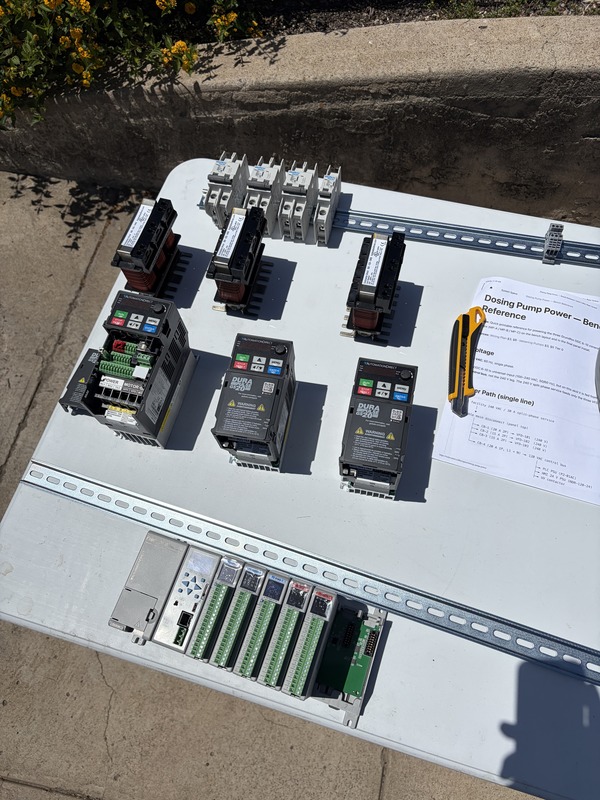
I'd had a bunch of experience with putting up outdoor enclosures for remote LoRaWAN gateways backhauling via cell, so the idea of an enclosure wasn't new to me.
I've bought enclosures from Allied Moulded $250 boxes down to $18 Amazon specials. They all worked well enough for what I needed then, which was a box that kept out the rain and the weather, didn't get too hot, and protected the guts of a fairly simple system (Raspberry Pi controller, modem, battery, inverter, and sometimes, small fans.)
However, I was lacking in experience in two places. None of those boxes had to pass code checks, and no one really cared what those looked like. They were all off on a mountain somewhere, and the sole goal was performance.
For JCWS, there are additional parameters to meet. This has to pass a code inspection, and because it's customer facing, it has to look good. Now, looks are subjective but passing code isn't, which brings us to our first point of discussion.
NEMA and IP Ratings: How to Match an Enclosure to Its Environment
Every (legit) enclosure you buy will have a NEMA (National Electrical Manufacturers Association) code and an IP (Ingress Protection / International Protection) rating. Both ratings refer to standards for protection from outside forces, from fingers to freezing rain.
NEMA
NEMA ratings define standards for the ability to protect against dust, water, ice, and corrosion. For example, NEMA 1 is for indoors, NEMA 3R is for outdoors, and NEMA 4X is for corrosion resistance.
IP
IP ratings are "IP" followed by 2 digits. The first digit (0-6) refers to the protection against solid objects like dust, fingers, etc. The second digit (0-9) refers to protection against liquids like water. The higher the number, the better the protection.
If you see an "X" in the number on an IP rating, it means it hasn't been tested for that factor.
What I needed on the NEMA side is at least a 1 (indoor), and on IP side is at least IP 54. IP 54 is dust-protected with limited splash resistance.
That matches how this enclosure actually lives inside our dessert shop in full view of customers. Nobody will hose down the cabinet, but closing-shift wipe-downs can splash sanitizer; we're better off being protected.
The Hoffman CSD362410 I ended up with carries NEMA/EEMAC Type 4, 12, and 13 ratings as well as an IP66 rating. NEMA 4 is windblown dust and rain, splashing water, and hose-directed water along with remaining undamanged by the formation of ice on the enclosure. Not going to happen in San Diego; we have perfect weather 340 days a year.
NEMA 12 & 13 means it's designed for indoor use to protect against lint, dust, fly-ins and dripping non-corrosive liquids like oil or coolants.
IP66 is dust-tight and protected against powerful water jets from any direction.
It's UL 508A listed, and cUL listed as well.
I kind of like overkill, but that's just me, and it can be an expensive habit.
What Material Should Your Hoffman Box Be?
In the same realm as far as protection from the elements is the material you choose. For indoor dry use like mine, painted mild steel is fine.
If you're putting this in a washdown or food prep environment look at 304 stainless. For chemical/marine applications, 316 SS is more likely to be what you need, and if your environment has corrosive but non-conductive needs, check out fiberglass.
How Much Does A Hoffman Box Cost?
When it comes to buying a box, you can buy exactly what you want from nVent or any of their distributors, but the cost will be high.
For the "Made in the USA" CSD362410 I bought, when I did a quick internet search and included shipping and tax, the landed cost was just above $2,000.
The secondary market is decent, so it's reasonable to hunt on eBay until you find something for about 20% of the cost of new.
In my case, an electrical contractor in Chino was selling a 36 x 24 x 10 box for $450. On Tuesday I offered $350 and pickup, and by Friday I had the box in hand and safely back in the shop for $75 in gas.
[INSERT PICTURE OF OPEN HOFFMAN BOX HERE, MAYBE IN BACK OF TRUCK]
For my purposes that's fine, but you may have different requirements. Obviously, if you're installing a Hoffman box on the side of a nuclear sub going through decon, you'll prolly want higher NEMA/IP ratings.
Those may not be the right reasons for you, but that's why I bought what I bought.
How To Size A PLC Control Panel Enclosure
I skipped over how I got to the dimensions, but it's pretty straightforward. Lay out everything you're using for the PLC, organize it in rows that'll mount on DIN rails, then measure it and give yourself plenty of finger-working space.
[INSERT IMAGE HERE OF ALL COMPONENTS IN BOX HERE]
Oh, and measure for heat. "Heat", you ask?
Heat In A PLC Enclosure
You need to consider the thermal load, asking two questions: What'll the external environment be like, and what are your components rated to?
For our San Diego dessert shop where we rely on natural ventilation and have a bunch of freezers pumping heat into the room, we're looking at temps as high as the 90s during the summer and down into the 50s in the winter.
The AutomationDirect stack (from PLC to tray to breakers to line reactors) doesn't have a consistent temperature limit. The HMI is rated to about +50 °C, the Productivity2000 family and GS20-class VFDs are generally +50–60 °C depending on part and derating — but the Gladiator miniature breakers are only +40 °C (104 °F).
That breaker limit drives our cooling choice, not the PLC.
Here's what you need to do: Add up watt-loss from everything on the subpanel (VFDs dominate), estimate how much heat the steel box can dump to the room at worst-case indoor ambient, and see what's left to move with air.
For the Hoffman CSD362410 I chose (36" × 24" × 10"), the internal dissipation lands near ~200 W and enclosure surface area near ~18.7 ft².
With hot-shop summer air in the ~90 °F / 32 °C range, I'm looking at a few hundred BTU/hr that still needs helping along after conduction through the walls. If ambient gets into the ~35–40 °C / 95–104 °F zone, the steel walls ain't up to the job and we're closer to moving the full ~200 W through airflow.
That means we'll use a filtered intake fan plus filtered exhaust in about the 100–150 CFM class.
I'll run it on a thermostat in the ~95–100 °F internal range so the fan isn't always screaming: 95 °F (~35 °C) inside is still safely under the +40 °C Gladiator cap, with margin for uneven hot spots near the drives.
That's the box
That's as much as I know right now about buying a PLC box. If you found this useful, go be awesome to someone. If you need help building your own world-class water system, drop me a line.